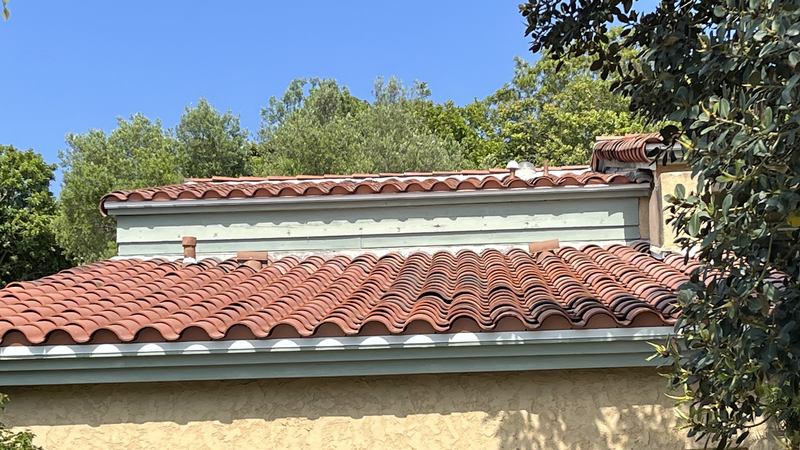
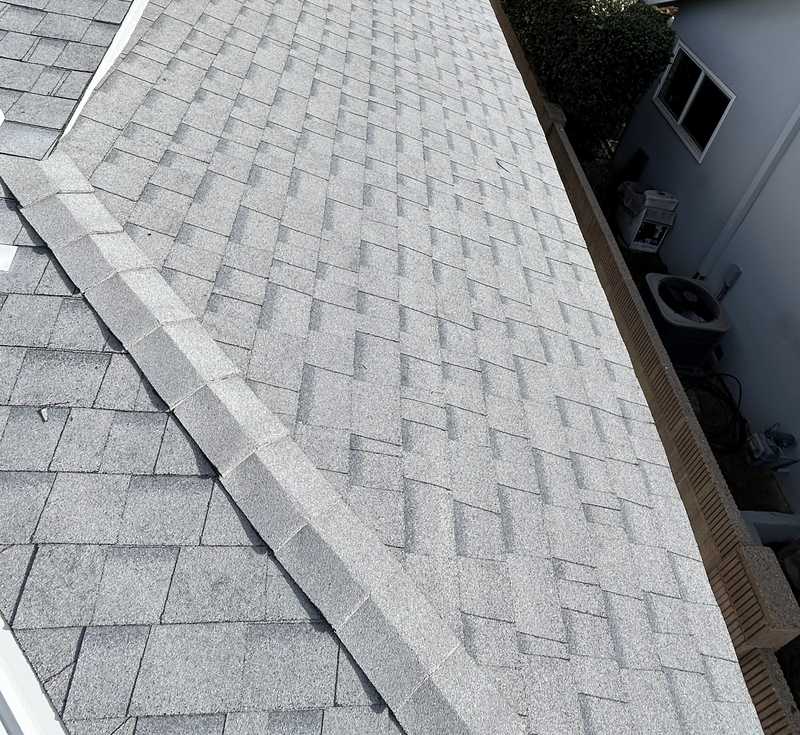
Most roofs here need one of three jobs. We repair the single failed detail, or we relay the tile over new underlayment. When neither option will hold, we remove the covering and begin again.
The wrong choice costs you money now, and it can cost you a whole roof later. So we inspect the roof first, and then we price the job it actually needs.
On this page
What you can see from the ground
You can spot most roof trouble from the yard, well before water reaches a ceiling. None of it requires a ladder or a climb. Walk the perimeter of the house slowly, and examine the gutters, the roof edge, and the roof plane itself.
Then check your ceilings inside. Look for these five signs.
Granules piling up in the gutter or under the downspout.
Tile that has slipped, cracked, or lifted out of line.
A ceiling stain that spreads a little further after every rain.
Daylight showing at the eave or through the attic boards.
A dip or a sag in the roof plane between rafters.
Each of those signals points somewhere different. Granules mean a shingle roof is losing its surface, and slipped tile means movement or a failed fastener. A spreading stain means water is still entering the building.
Ceiling stains and attic daylight are worth a call sooner rather than later. Water that reaches drywall has usually been inside the roof assembly for a while. Tell us what you have observed, and we will handle it from there.
Finding where the water gets in
Water gets in at one spot and drips out at another. It runs along rafters, sheathing, and pipes before it finds a way through the ceiling. That is why we begin our diagnosis at the flashing on walls, chimneys, valleys, and vent pipes.
Flashing is the metal that seals those transitions. It deteriorates far more often than the open field of a roof. Vent boots crack, valley metal corrodes, and wall joints separate as the house moves.
Once we identify where the water enters, we can price the repair. Our roof repair page explains the same diagnosis in greater detail.
When a repair is the right call
A repair suits one failed spot on a roof that still has years left in it. Cracked vent boots, a lifted shingle course, a slipped tile, or an open flashing joint all qualify. The remainder of the covering keeps performing while we repair the section that failed.
We take small repairs as readily as complete roofs. If a patch will only carry you through a single wet season, we tell you before you spend money.
Relaying tile over new underlayment
Underlayment sits under the tile and performs the waterproofing, so it typically wears out first. The tile itself often outlasts that sheet by several decades. A lift and relay replaces the sheet, repairs the deck, and puts your own tile back on.
A lift and relay runs like this:
We lift the tile off in sections and stack it on site.
We strip the failed underlayment down to the deck.
We check the sheathing and replace any boards that have rotted.
We lay new underlayment across the deck.
We put your own tile back on top.
A relay usually costs less than a complete tile replacement, because your existing tile stays on the job. Some pieces break during lifting and restacking, so every estimate carries a tile allowance. Our tile roofing page covers the entire system.
When a roof needs a full tear off
Age alone does not tell us what sits under a covering; a tear-off removes the covering down to bare sheathing. Once it is off, we can evaluate the condition of the boards underneath. We show you the damaged wood, replace it, and itemize it on the invoice.
Rot in the deck is the most common surprise on a tear-off. It appears at valleys, at eaves, and around older pipe penetrations.
Laying a new covering over an old one hides the problem you are paying to repair. Our roof replacement page explains that route.
Choosing a roof system
We match the system to the building, the pitch, and what the code allows at that address. Four coverings do most of the work here: asphalt shingle, tile, standing seam metal, and low-slope membrane. The roof itself usually narrows that list quickly.
Asphalt shingle
Shingle is the typical answer on the detached houses here, and our asphalt shingle roofing page covers it. It tears off cleanly, patches easily, and suits the pitches on this housing stock. It is also the easiest covering to match when only a portion of a roof has failed.
Tile
Clay, concrete, and slate tile all show up on roofs around Mayflower Village. A cracked or slipped piece here and there is usually a repair. A worn sheet under sound tile is a relay, and failed tile is a replacement.
Metal
We install standing seam metal, and our metal roofing page covers the system. The fasteners hide inside the raised seams, so no screws appear on the panel face. Standing seam suits simple planes, long runs, and roofs with few pipes to work around.
Low slope sections
Porches, additions, and garages often carry almost no pitch, and flat roofing covers those sections. We use torch-down modified bitumen there, with a reflective white cap sheet where it suits the building. Those sections leak first, because the steeper planes above them drain onto that limited area.
Two systems often meet on one house here. A shingle or tile main roof drains onto a low-slope porch or garage. That is when a slow leak becomes a wet ceiling.
Not sure which one fits your house? Call (626) 323-8814 or send the contact form, and we will help you choose one.
Permits and code for an unincorporated area
Mayflower Village is an unincorporated community, so the county handles building permits. Los Angeles County Building and Safety is the place to begin with permit and inspection questions. We help you prepare and file the roofing permit application, and the county decides the remainder.
Ask the county what your address requires before you schedule the work. Fire regulations matter here too, and they depend on whether your address sits in a mapped hazard zone.
A roof fire rating belongs to the entire assembly, not to one product on its own. Laboratories test those assemblies to ASTM E108 or UL 790, and that test establishes the Class A rating. So a single product label never demonstrates that your roof is Class A.
Outside a mapped fire hazard severity zone, California sets Class C as the minimum requirement. The state relocated its wildfire roofing rules into the Wildland Urban Interface Code at the beginning of 2026.
When you ask for an estimate, we price the roofing work at your address for free. Escrow files and insurers sometimes need a written condition report, and that one is a paid service. That paid inspection ends with a written report, so the two options answer different questions.
Tell us on the phone which one your situation requires. Our roof inspection page has the details on the paid report.
What changes the price
We price from actual measurements, so the square count opens every estimate. One roofing square covers one hundred square feet of roof area. We measure the roof surface itself, so a steep or complicated roof holds more squares than its footprint suggests.
After that, the roof itself moves the number:
How many stories the house has, and whether we can get a truck close.
Pitch, because a steep plane slows every stage of the job.
The number of coverings already sitting on the deck.
Deck condition, since rot adds boards, fasteners, and hours.
Whether tile has to come off and go back on.
Whether the address sits in a mapped fire hazard zone.
In a mapped High or Very High zone, one state regulation changes the job. Replace half the covering or more within twelve months, and the roof must satisfy new construction requirements. That usually means a Class A assembly.
Every one of those appears in the written estimate, so you can see how we built the number.
We repair and re-roof houses in Census ZIP Code Tabulation Areas 91006 and 91016. Your own valleys and low-slope tie-ins decide how the roof handles a storm. We detail that junction carefully, because that is where the two systems must operate together.
Drainage decides how a roof here handles winter. Southern California packs most of its rainfall into a short winter season. Valleys, flashings, and low-slope sections absorb the worst of it.
Get a free roof quote in Mayflower Village
Tell us the address, the covering, roughly how old it is, and what you have noticed. Repair, relay, and replacement each fit a different condition. We scope the roof, put it in writing, and tell you which route it supports.
Call (626) 323-8814, or send it through our contact form for a free quote.
Repair, relay, and replace price differently on the same house, so one roof can carry three very different numbers. What the roof actually needs decides which of the three we quote. The answers below cover the questions we hear most in Mayflower Village.
How much should a 1500 sq ft roof cost?
Square footage of the house tells us very little about the roof above it. We measure the roof surface, so a steep or complicated plane holds more squares than the footprint suggests. Repair, relay, and full replacement then price differently on the same house.
What is the 25% rule for roofing?
The California rules carry no 25 percent trigger. They set the threshold at half the roof inside mapped High and Very High fire hazard severity zones instead. Cross that threshold within twelve months and the roof must meet new construction requirements.
What is the cheapest time of year to get a new roof?
Roofing work here peaks after the first winter storms and eases through late spring. A relay or a full tear-off books more easily in the quieter months. Call us the week you notice a leak or a spreading ceiling stain, whatever the season.