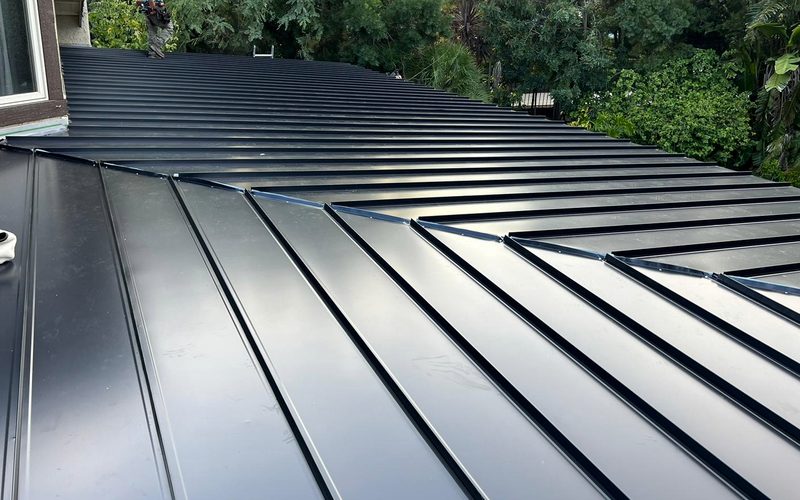
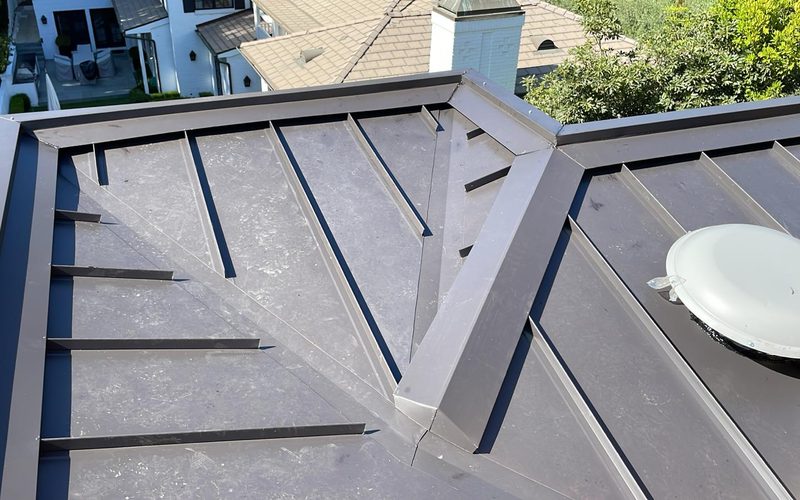
A standing seam metal roof covers a building with long panels and very few exposed fasteners. We install those roofs in El Monte, and we repair the metal roofs already up there.
We are El Monte Roofing Contractors, and metal is one of the systems we build. Call us at (626) 323-8814, and your estimate is free. Tell us what the building has now and what you want on it instead.
On this page
What standing seam metal roofing is
Standing seam is a panel system instead of a field of small overlapping pieces. Long panels run from the ridge down to the eave in one length. Raised seams join those panels along their edges and lift the joint above the water.
Each seam locks two panels together and keeps that joint clear of the water path. The fasteners sit under the seam, out of the weather.
Nothing screws through the open face of a panel, so the field carries no gasket holes. Roofers call that a concealed fastener system.
How we install a standing seam metal roof
We strip the old covering to the sheathing, repair bad boards, and lay new underlayment. Then we set the panel layout, fabricate the panels, and seam them from eave to ridge. Trim, closures, and flashing finish the edges and transitions.
Before any material comes off, we cover the landscaping, the walkways, and the vehicles. Then the tear-off starts, and it goes all the way down to the decking.
We show you any rotten sheathing, price the repair, and get your approval before we close the area up. Rot in the decking is the most common reason a price moves after we start.
Then the panels go on. We cut them to the measured lengths, so most runs reach from eave to ridge in one piece. Setting the layout first keeps seams and cuts clear of the path water takes.
Clip selection and fastening have to allow for panel movement and the design load on your building. The Metal Construction Association standing seam clip guidance sets that out. The panel manufacturer or a qualified engineer gives the direction for your roof.
We finish the ridge, eave, valley, and wall details last. Then we clean the site and take our own scrap and packaging with us.
24 gauge panels and concealed fasteners
We install 24 gauge panels on the metal roofs we build. Gauge measures the thickness of the metal, and a lower number means thicker steel. Thicker panels hold their shape better across long runs and stand up to foot traffic.
How long a panel lasts depends on the product, the coating, and the detailing around it. The coating and the base metal differ from one manufacturer to the next.
Our written quote names the panel product, the gauge, and the finish. It names the color as well, since that is what you see from the street. You get all of that in writing before we book the work.
What sits under the panels
A metal roof still rests on the decking and framing underneath it. On a replacement we strip the old covering back to the sheathing and check every board. New underlayment then goes down across the repaired deck before the first panel arrives.
Underlayment is the water resistant layer between the decking and the covering above it. The panels shed the weather, and the underlayment sits behind them.
An overlay leaves the old covering in place under the new panels. We tear off instead when nobody has seen the deck. We also flag anything wrong in the framing while the roof is open.
Flashing at walls, valleys, and pipes
Metal panels rarely fail in the middle of an open plane, because that surface simply sheds the water. Water enters a building where the roof meets something else, such as a wall, chimney, or pipe. So the flashing plan carries most of the risk on a metal roof, and we detail it carefully.
Flashing is the metal that seals those joints, and it is a leading source of roof leaks. We shape and detail it at walls, chimneys, valleys, eaves, pipes, vents, and curbs.
Every pipe and vent interrupts a straight panel line across the roof. We place the layout so those openings land between seams wherever the roof allows.
Panels go on quickly once the layout is right. The flashing details take longer, and they are the part we check hardest.
What we check when a metal roof leaks
A leak call starts inside, at the stain on the ceiling. Water runs along the framing before it drops, so the wet spot rarely sits under the entry point. We work back from the stain to the detail that let water in.
We ask when the stain first appeared and whether it grows during rain. Those two answers narrow the search before anyone goes up a ladder.
On the roof we look at seam condition, fastener lines, and the flashing at every wall and chimney. We check valleys, pipe boots, vents, and curbs as well.
Debris and drainage matter as much as the metal itself. Leaves packed into a valley hold water on the roof long after the rain stops.
Then we tell you what we found. Sometimes we rebuild one detail, and sometimes the layers under the panels have to come off. When the problem is a leak rather than the system, our roof repair page covers that work.
Metal roof repair or full replacement
Not every metal roof needs replacing the moment a leak appears on the ceiling underneath it. We repair leaks, failed flashing, damaged panels, and loose seam work, including the smallest individual jobs. Replacement becomes the honest recommendation when the decking or the underlayment below the panels has already failed.
A single flashing repair is a normal call for us, and it is often all a roof needs. Panels can look sound long after the layers below them stop working.
When repair and replacement both work, we price both and you choose. Our roof replacement page explains the full tear-off.
Metal roofing on El Monte houses
We install metal on a whole roof, on a single slope, or on a patio cover. Each of those choices changes the detailing, the material list, and the installed price of the project. A patio cover is a small job on an El Monte house, and we take those too.
A partial metal section has to meet the existing covering cleanly, and that joint takes the most planning. Tell us what the house has on it now and how you want it to look.
We take metal work in the Mountain View and Norwood-Cherrylee neighborhoods of El Monte. We cover 91731, 91732, and 91733 too, areas the Census uses to organize local data.
Metal roofing on commercial and multi-unit buildings
We install and repair metal roofing on commercial and multi-unit buildings as well as houses. On a low-slope commercial roof, torch-down modified bitumen is often the better system choice. We say so plainly whenever that system suits your building better than metal panels would.
The roof, the access, and the daily use of the building all shape the right system. On an occupied building we plan staging and timing before we quote the work.
We take both repair work and replacement work on commercial metal roofs. Our commercial roofing page covers that work.
How metal compares with the other systems we install
We also install asphalt shingle roofing, tile roofing, and low-slope commercial systems in El Monte. Metal suits a roof where you want concealed fasteners and long unbroken panel runs from ridge to eave. Your slope and your current covering point to the right system here.
If your roof is tile, the answer is often a lift and relay instead of a whole new system. That job reuses the tile you already own. See our tile roofing page.
If the building is low-slope, torch-down modified bitumen is our usual answer. Our flat roofing page covers that system. On a steep roof with a tighter budget, asphalt shingle roofing is usually the practical choice.
Each system suits a different slope, structure, and budget. We compare them once we have measured the roof and seen the plans. Call us at (626) 323-8814 and we will recommend a system.
Permits and fire zone rules
If your metal roofing project requires a city permit, we help you pull it before installation begins. Permit questions turn on the property address and on the exact scope of the planned work. Fire zone mapping can also change what the building code requires on your particular roof.
Fire hazard severity mapping decides which rule applies to your address. Inside a mapped High or Very High zone, reroofing follows a stricter covering rule. It treats the roof as new construction once you replace half the covering or more within twelve months.
That requirement applies to the whole roof assembly rather than to the panels alone. Outside those mapped zones, the state minimum is Class C.
We look up the fire zone mapping for your address before we quote. Your estimate then names the roof assembly we plan to install.
What moves the price of a metal roof
Size comes first, and we measure the roof in squares of one hundred square feet. Stories, pitch, access, rot under the old covering, and the panel product move it from there. Extra layers under the old covering add weight and labor to the tear-off.
The finish and the amount of flashing matter as well. Fire zone requirements can change the material list on a metal roof. Long panels also need room on the ground, so a tight lot changes how we stage the work.
We start from aerial imagery, then confirm the measurements on the roof itself. That first pass tells you early whether a metal roof fits the budget.
The estimate is free. A written report for escrow, or for an inspection an insurer requires, costs a separate fee. That fee follows roof size and the number of stories, and our roof inspection page explains it.
When to schedule metal roof work
Rain arrives here in a short winter window, and the rest of the year stays dry. Work we book in the dry months runs into far less rain than winter work does. So the calendar shapes when we can realistically start a metal roofing project in El Monte.
Most leaks show up on the first wet night after that long dry stretch. That is when the phone starts ringing across El Monte and the San Gabriel Valley.
Our schedule fills up in the wet months, so book early when you can. Call us even when the work is months away, and we will still take it.
Talk to us about your metal roof
Call us at (626) 323-8814 for a free estimate on your metal roofing project. You can also send your roof details through our contact form with the address and a short description. Either way, the estimate on your metal roof project costs you nothing at all.
We work in El Monte and nearby cities such as Temple City, Rosemead, and South El Monte. Our service areas page lists every place we cover.
Tell us what the roof is doing and we will explain the options. Our El Monte roofing homepage covers the rest of the work we take.
Frequently Asked Questions
Metal roofing raises a different set of questions than shingle or tile roofing does. Water gets past a metal roof at the details rather than through the panels themselves. The answers below cover that flashing work and what moves the price of a metal roof.
What is the biggest problem with metal roofs?
The details cause far more trouble than the panels themselves. Flashing at walls, chimneys, and valleys is a leading source of leaks on any roof. Any metal roof quote should spell out the flashing work at each of those spots.
What is the average cost of installing a metal roof?
We measure the roof in squares, then price the stories, the pitch, and the access. The panel product, the finish, and the amount of flashing metal all move the number again. Your estimate on a metal roofing project is always free.
How much is 1000 sq ft of metal roofing?
We price an installed roof rather than material by the square foot. Panel gauge, trim, and the flashing at walls, valleys, and pipes all sit inside that price. We build standing seam in 24 gauge, with the fasteners concealed under the seams.