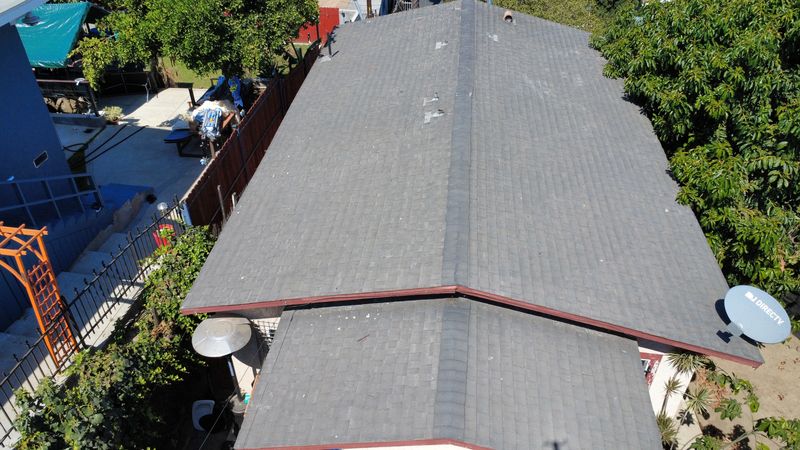
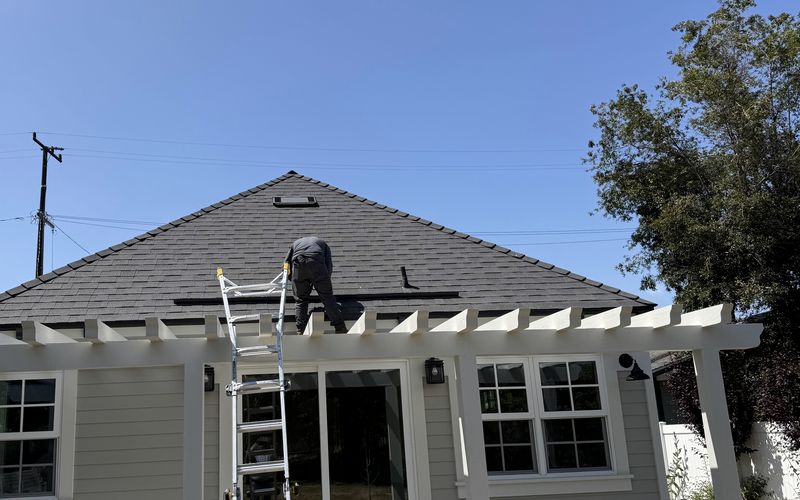
We are El Monte Roofing Contractors, and we roof houses and small apartment buildings across San Gabriel, CA. On tile we lift the covering and replace the underlayment beneath it. On shingle we tear off to the decking, repair any rotted wood, and rebuild the flashing.
Age alone never tells us what a San Gabriel roof requires. We examine the flashing, the underlayment, and the decking instead. Ask us for a free estimate on the roofing work you need.
On this page
How we relay a tile roof, step by step
Tile normally outlives the underlayment beneath it, so the tile itself is usually still good. The underlayment wears out first, which is why a relay is not the same job as a new roof. We lift the tile, replace the layer that leaks, and reinstall your original tile.
We remove tile a section at a time and stack it nearby.
We clear the worn underlayment off the sheathing.
We inspect the decking and replace any board that has rotted.
We install new underlayment.
We relay the same tile you started with.
Breakage occurs on every relay, so each estimate carries a tile allowance. The estimate also names the price per tile above that allowance. That way you know the tile cost before the work starts.
We rebuild the flashing at roof to wall joints, chimneys, and valleys while the tile is off. Our tile roofing page covers the entire system, including clay, concrete, and slate.
Shingle roofs and the layer count
On shingle roofs the number of coverings already on the decking drives the job. Each additional layer adds weight, conceals rot, and costs more to remove later. A tear-off returns the roof to bare sheathing, where we can inspect the decking.
Older San Gabriel roofs usually carry the marks of earlier work. Mismatched shingle courses, patched flashing, and tar smeared over a joint tell us exactly where to look. Tar over a joint usually indicates an old leak, so we examine that area carefully.
We also inspect the eaves and the valleys for soft sheathing beneath the covering. Rot in the decking is the most common reason a roofing estimate changes.
Apartments, duplexes, and low slope sections
Smaller multi unit buildings in San Gabriel can combine a pitched roof with a flat section. That flat area may sit over walkways, garages, or an addition. We price both surfaces in one estimate instead of separating them into two projects.
Torch-down modified bitumen is our standard low-slope system. We install TPO as well, though it costs more and later repairs become more difficult.
We take this work across San Gabriel, including buildings in Census ZCTAs 91770 and 91776. See flat roofing and commercial roofing for how those systems go together. On an occupied building we schedule the work in phases so the property stays in use.
The San Gabriel streets we cover
We roof detached houses, attached homes, and multi unit buildings across San Gabriel. We still price each roof from the condition we find on it today. We take the same work on San Gabriel streets inside Census ZCTAs 91108, 91755, 91775, 91780, and 91801.
Rain and drainage on a San Gabriel roof
We ask where your roof sends its water, and we check that path before we quote. We detail the valleys and the edge metal so rain leaves a San Gabriel roof quickly. On a flat section we apply the same detailing at the drains and the seams.
Permits, code, and mapped fire zones
We can help you obtain the roofing permit when your city requires one. Whether your roof needs a permit depends on the scope, and the city makes that determination. Fire hazard severity zone mapping can also change the covering at some addresses.
In a mapped High or Very High zone, replacing half the covering within twelve months triggers the new construction rule. Outside those zones, the minimum California standard is Class C. A fire class describes the finished roof assembly, not a single product on it.
The 2025 Title 24 code is in force across California. You can read the current edition through the California Building Standards Commission. Cities may amend it, and the state keeps those filings on record.
You can verify CSLB #1112525 in the state's Check a License lookup.
What moves the number on your estimate
We price a roof from what we measure and from what we discover on it. Roof area, pitch, layer count, and deck condition move the number more than anything else. The list below covers the conditions that change a San Gabriel estimate most often.
Roof area and the number of stories, which set most of the labor.
Pitch, because a steeper plane slows the work down.
The number of coverings already sitting on the deck.
Rot in the decking, which adds both material and hours.
Tile that has to come off the roof and go back on.
A mapped fire zone, which can change the entire assembly.
A free estimate and a paid written report
We price the roofing work we would do for you at no charge. A written roof report is a separate service, and we charge for it. A sale in escrow or an insurer renewing a policy usually requires that report.
Ask for the report when you need the documentation rather than a price. See roof inspection for what the written report contains.
Get a San Gabriel roof estimate
Call (626) 323-8814 with the address, the covering type, and roughly how old the roof is. We price each roof from what we measure on it; you can also send those details through our contact form. Those details tell us what to prepare for before we arrive.
Older San Gabriel roofs often carry patched flashing and more than one covering. If a relay and a full replacement are both possible, we will price them side by side. Phone (626) 323-8814 with the covering type and the roof's rough age.
How much should a 1500 sq ft roof cost?
Two San Gabriel roofs of that size can price differently, because the conditions differ. We measure the roof, count the coverings on the deck, and check the sheathing before we quote. Tile that has to come off and go back on adds hours to the same size.
What is the average cost of replacing a roof in California?
A statewide average mixes thousands of different roofs together, so it cannot price yours. On an older San Gabriel house, the layer count and the tile handling usually decide the number. Rot in the decking is the other item that changes an estimate after we open the roof.
How to tell if a roofer is lying?
Check the license number yourself through the state Check a License lookup before you sign anything. Then read the written scope, which should name the tear-off, decking, underlayment, and flashing. A scope that names the tile allowance and the decking rate leaves less room for surprises.